The investigations I have undertaken into 1980s British comedy that led me to the subject of my previous post have taken an intriguing turn into the study of the essence of comedy itself. What is it, exactly, that makes something funny? Furthermore, how is it that some people are better than others at the skill of constructing humor, especially in the moment?
Mr. Pants: “You’ve really worked out your banter, haven’t you?”
Blackadder: “No, this is a different thing. It’s spontaneous and it’s called wit.”
– Blackadder II (1986)
Some performers are far more comfortable with doing scripted work rather than live, which includes many comedic performers. This preference is likely, at least to some degree, proportionate to the performer’s ability to smoothly and successfully recover from mistakes made when performing live, an ability which heavily relies on the skill of improvisation. My previous post discussed the comedian Rik Mayall at length, as well as his creative partner, Adrian Edmonson, and this is an excellent opportunity to circle back to those skilled actors for a moment to illustrate this point. During the “Bottom Live” tour of 1993, one of their performances was recorded on video. Famously, there is an eight minute sequence which kicks off at approximately the 1:19:11 mark (LINK) when “Eddie” gives a particularly over-dramatic performance of one of his lines that leads to an unexpectedly massive audience applause, ultimately resulting in Rik losing his place within the piece. This precipitates a sort of improv “showdown” between the two performers, which Adrian (at least, on this occasion) repeatedly “wins” while staying in character and breaking the fourth wall several times. This sequence is a remarkable example of how a high degree of improvisational skill can not only help recover a live performance that has become derailed, but also serve to amuse the audience greatly while doing so.
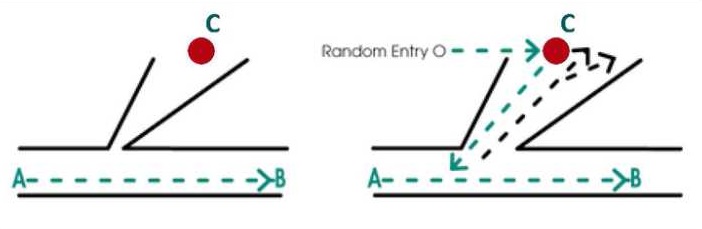
How are performers like Rik and Adrian able to marshal such wit “on the fly”? The definition of the ability to improv was one of those things that I felt I knew on some level and yet struggled to put into words. However, the answer came to me from none other than the famous comedian of Python fame, John Cleese, in one of his academic speeches where he named a certain author as personally very influential: Edward De Bono. De Bono’s concept of “lateral thinking” quite literally is the mechanism of improv and of wit itself (note that I did not claim this to be “humor”, since lateral thinking is not required for the performance and enjoyment of several types of comedy, such as slapstick, for example, which many people find amusing). Lateral thinking involves the ability to take a concept or idea and invoke as many different connections of relationship to other concepts or ideas as possible. An example of this from the “Bottom Live” improv showdown involves Adrian saying “My arm’s getting tired now,” in reference to the fact that he’s been holding a pose for several minutes while the show has stalled in its tracks due to him milking audience applause, to which Rik responds with a smirk, “That’s not why your arm’s getting tired.” This reference is, obviously, to masturbation, which the audience clearly understands and immediately responds to with a round of laughter. Adrian’s lateral thinking then kicks in, as he quickly makes a connection from the idea of masturbation to the fact that Rik’s character of “Richie” has been canonically established not only to engage in that practice to excess but also has a self-reported small penis, and mere seconds pass before “Eddie” fires back with, “Yeah, well at least it’s my arm and not just my wrist!” to massive audience approval.
Edward De Bono, the originator of the term “lateral thinking”, was a Maltese physician who held faculty appointments as several prestigious universities such as Harvard, London, Oxford, and Cambridge. He was a prolific author, and wrote 85 books, many of which dealt with the skill of lateral thinking and how to both learn and teach it. Beyond books on the subject, he also taught his methods in person to audiences both big and small, public and private, including corporations, government agencies, and various organizations. A wonderful lecture series he did for the BBC can be found publicly available on YouTube (LINK) and I highly recommend it. My husband actually had mentioned De Bono’s book “Teaching Thinking” to me several years ago as suggested reading, and I am now working my way through it.
The takeaway from this study has been my amazement and enjoyment that my pursuit of British comedy has led me from “alternative comedy” to the Python troupe and now to what I consider the very heart of wit itself. I had been at a loss of what to write for my February blog post, but I am glad that I finally settled on this very intriguing and educational intersection. I attended my first live improv show a couple of weeks ago at a local Albuquerque theatre (The Box), and I hope to see many more (and maybe even try it a bit myself…).
 Sauvryn Arts • Tara Carter